


By Lori Leath Miller
Summer in Freeport brings plenty to love: long days, backyard gatherings, ballfields full of families, time on the water and evenings that stretch just a little longer. But along with the sunshine and afternoon rains comes another familiar part of life in Northwest Florida — mosquitoes.
This year, Freeport residents mmight notice something new behind the scenes. The City of Freeport now has its own mosquito control program, giving the fast-growing community a more localized approach to one of Florida’s most persistent seasonal challenges.
As Freeport continues to experience rapid growth, city leaders established Freeport Mosquito Control in October 2025 to provide a more localized approach to mosquito management. According to city information, the goal is to preserve the health and comfort of Freeport residents through informed and responsible mosquito control practices. The city now conducts its own surveillance, monitoring and treatment efforts tailored to conditions within the community.
Rather than simply spraying on a set schedule, Freeport’s program is built around surveillance. The city operates eight permanent mosquito traps across Freeport and places additional traps in areas of concern. Those traps are baited with carbon dioxide, using dry ice to imitate human breathing, then left in the field and retrieved 24 hours later.
What happens next is where the science comes in. Mosquitoes collected from the traps are identified by certified personnel. That matters because Florida has nearly 90 species of mosquitoes, and not all behave the same way. Different species prefer different habitats, bite different hosts and carry different levels of disease concern.
The city also monitors mosquito larvae, treats problem areas before mosquitoes become adults and uses mosquito fish, also known as Gambusia, in more permanent bodies of water such as retention ponds, wooded pools and some ditch systems. In areas where water may dry up but still produce larvae, bacterial treatments are used to target mosquito larvae while limiting impact to people, pets, fish, birds, amphibians and other wildlife.
Storm drains are also part of the plan. Because water can collect inside them and create ideal breeding conditions, Freeport treats storm drains twice each year using alternating products, including bacterial treatments and methoprene, an insect growth regulator that prevents mosquitoes from reaching adulthood.
Even with those efforts, some adult mosquitoes still take flight. According to the city, when adult mosquito traps consistently catch more than 25 mosquitoes in a night, it may be time to send out the spray truck. The city uses ultra-low-volume spraying, which distributes small droplets of adulticide into the air.
As of mid-June, Freeport had posted 2026 mosquito trap reports on the city website, including reports from May and June. The city also began making public spray announcements when trap counts remained high. One recent notice stated that spraying would begin about one hour before sunset and continue into the evening.
That does not appear to mean Freeport has a fixed weekly summer spray calendar. Instead, the city’s approach appears to be based on trap counts, mosquito activity, weather conditions and areas of concern. Residents looking for updates can check the city’s mosquito trap reports and watch for city announcements.
As a resident, you also play an important role. Mosquito control works best when neighborhoods help reduce breeding areas around homes and businesses. Even small amounts of standing water can produce mosquitoes, including water in buckets, flowerpots, birdbaths, clogged gutters, toys, tarps, trash can lids, pet bowls and low spots in yards.
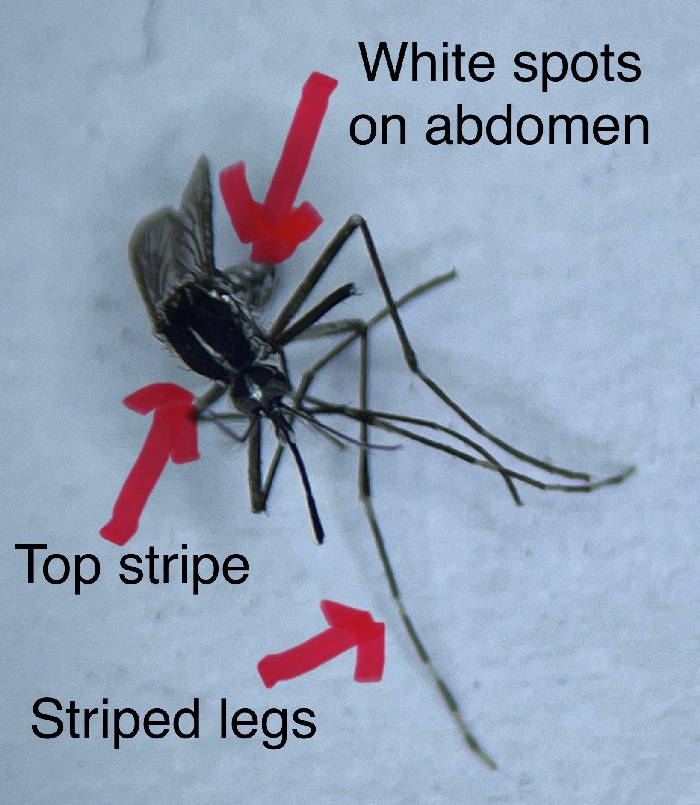
City officials are also asking residents to keep an eye out for one of the area’s most common backyard mosquitoes: Aedes albopictus, better known as the Asian tiger mosquito. These small black-and-white striped mosquitoes live in close proximity to humans and rarely travel more than about 700 feet from where they hatch. Because they stay so close to home, you might be unknowingly raising them in their own yard!
Their larvae can develop in almost any container that holds water, including flowerpots, children’s toys, buckets, tires and other items left outdoors. If you spot standing water with tiny wiggling mosquito larvae swimming in it, simply dumping the water can make a big difference.
Otherwise, a few simple habits can help reduce mosquito populations throughout the community: empty standing water weekly, keep gutters clear, refresh birdbaths, store containers upside down, maintain pools and fountains, repair screens and use repellent when spending time outdoors at dawn, dusk or after heavy rains.
Freeport Mosquito Control officials say these small efforts can have a significant impact. By eliminating breeding sites around homes and businesses, residents help protect their families, neighbors and the broader community from mosquito problems before they begin.
For Freeport, mosquito control is more than a comfort issue. It is part of public health, quality of life and keeping outdoor spaces usable during the summer months. Having our own local program allows Freeport to respond to conditions close to home, from neighborhood complaints to trap counts in specific areas.
For questions or concerns, contact Freeport Mosquito Control at mosquitocontrol@freeportflorida.gov. The city’s main number is 850-835-2822.
In Florida, mosquitoes may always be part of summer. But in Freeport, the fight against them is becoming more local, more data-driven and more visible — one trap, one treatment and one neighborhood at a time.
Visit freeportflorida.gov/government/department/mosquito_control.php for more information.