

By Lori Leath Miller
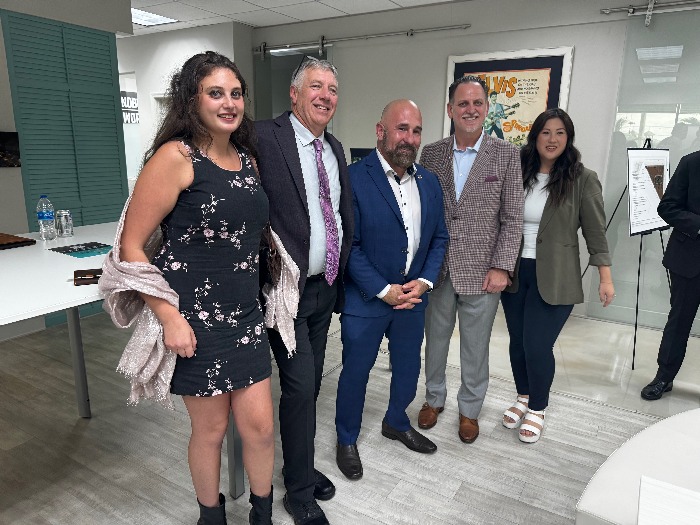
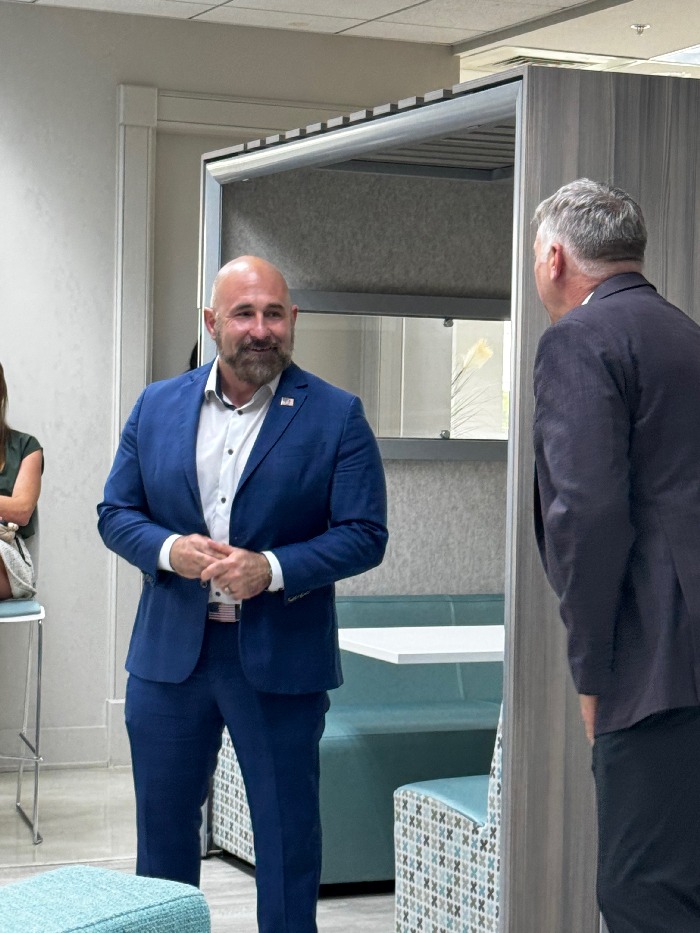
Florida Lt. Gov. Jay Collins visited Beachworx recently for a community conversation with local business owners, elected officials and residents, sharing his personal story, leadership philosophy and views on issues affecting Northwest Florida.
Collins, a former Green Beret, state senator and nonprofit leader, opened with a message rooted in resilience and service. He described being born to a teenage mother, adopted by his grandparents and raised on a family farm that was later lost. “A son never forgets,” Collins said, referring to a phrase passed down by his father. “You don’t forget where you come from. The roots that create who you are drive you.”
Collins served in the Army as a Green Beret, surviving serious injuries that ultimately led to the amputation of his leg. Afterward, he requalified as a Green Beret and continued serving for five more years. He later led a nonprofit that provided millions of meals after disasters, including hurricanes across Florida. “Leadership isn’t about talking,” he said. “Leadership is about being on the ground where people need help.”
Throughout his remarks, Collins emphasized that government, business and the economy are ultimately about people. He said his priorities have remained consistent from his time in the Florida Senate to his current role as lieutenant governor: safety, the economy, education and opportunity. “It’s not about me,” he said. “It’s about we.”
Education and workforce development drew significant attention during the question-and-answer portion. Collins voiced support for school choice while also emphasizing accountability. He said most Florida students will continue to attend public schools and said every educational option receiving public dollars should be held responsible.
He also called for stronger alignment between education and the workforce, particularly through trades, apprenticeships and career pathways in high school. “I don’t believe in second-class citizens,” Collins said. “We have to equally reward people who go down different paths, whether that is college, trades, entrepreneurship or going straight into a career.”
Collins said Florida should better connect commerce, universities, state colleges and high schools to identify workforce needs. He pointed to shortages in trades and agriculture, noting the average age of both tradesmen and farmers is near 58.
Questions also focused on housing affordability, insurance and the challenge of retaining skilled workers in tourism, health care and construction. Collins said the state must pursue short-, mid- and long-term strategies, including veteran transition programs, apprenticeship opportunities and policies that reduce the cost of building and owning homes.
He said permitting and impact fees are adding significant costs to home prices and should be part of the affordability conversation. On insurance, he said Florida has made progress attracting more insurers but still has more work to do, particularly related to fraud, litigation and rebuilding barriers after storms. “We cannot allow the conversation about affordability and the American dream to be about just getting by,” Collins said. “I want homeownership to be on the rise.”
Growth and development were also part of the discussion. Collins said Florida must manage growth thoughtfully while protecting farmland, water, beaches and green spaces. “People are going to move here,” he said. “The question is how we manage growth while keeping Florida what it is.”
Local attendees also asked about small business concerns, agriculture costs, women entrepreneurs, wildlife rescue funding and community projects, including an America 250 initiative called Patriots Point. Collins repeatedly encouraged residents to bring specific facts, maps and details to the table. “Come with details and we can talk problems,” he said. “You will have a seat at the table.”
For the Panhandle, Collins said the region’s military and veteran population is especially important to him. “If you signed your name on the dotted line, the very least we can do is be present, hear you out and help make a difference in your life,” he said.
Collins closed by returning to the theme of opportunity, saying his own life is proof that the American dream remains possible. “When people tell you the American dream isn’t real, they’re wrong,” he said. “I’ve lived it.”